
 English

News
Focus on G AND N FORTUNE LIMITED - Get to know the new information of the industry quickly!

2026-11-17 10:37:30
Hydroponic systems allow plants to grow without traditional soil by delivering water and essential nutrients directly to their roots. There are seven commonly recognized types of hydroponic systems: Deep Water Culture (DWC), Nutrient Film Technique (NFT), Drip System, Ebb and Flow (Flood and Drain), Wick System, Dutch Bucket System, and Aeroponics.
Each hydroponic growing system uses a different method to supply water, nutrients, and oxygen to plants. Some are suitable for leafy greens and herbs, while others are better for larger fruiting crops such as tomatoes, cucumbers, and peppers. Understanding the different types of hydroponic systems can help growers choose the right solution for their crops, growing space, and production goals.
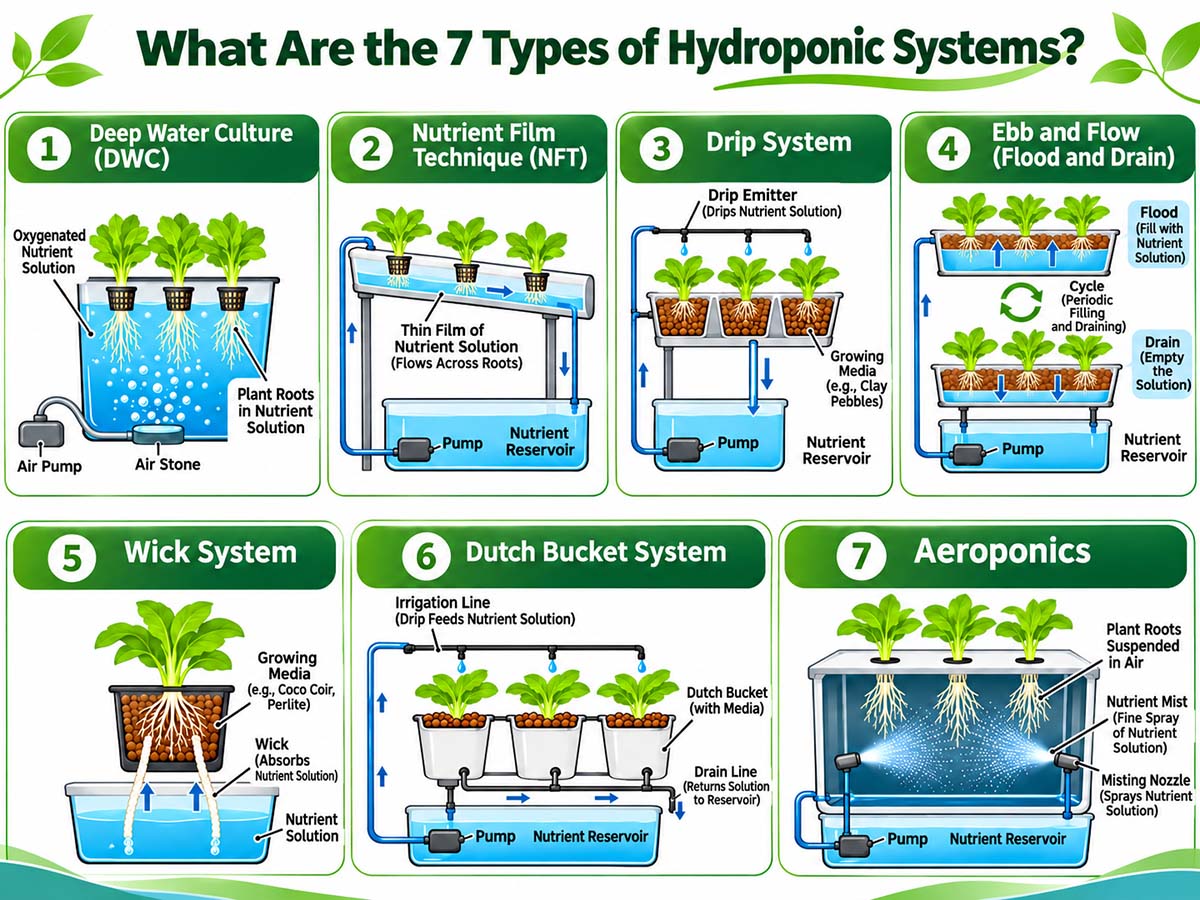
Deep Water Culture (DWC) is one of the simplest types of hydroponic systems. In this method, plant roots are suspended directly in an oxygenated nutrient solution, usually held in a reservoir or growing container.
An air pump and air stone supply oxygen to the water, helping prevent root suffocation and supporting healthy plant growth. Plants are commonly held in net pots positioned above the nutrient reservoir.
Key Features of DWC:
Plant roots remain submerged in nutrient-rich water.
An air pump provides oxygen to the root zone.
The system has a relatively simple structure.
Water and nutrient levels need regular monitoring.
Suitable for small-scale growing and commercial leafy green production.
Common Crops:
Lettuce, basil, spinach, kale, and other leafy vegetables and herbs.
Nutrient Film Technique (NFT) is a popular hydroponic growing method in which a thin, continuously flowing layer of nutrient solution passes through slightly sloped growing channels.
Plants are supported by net pots placed in openings along the channels. Their roots extend into the channels and absorb water and nutrients from the flowing solution. The remaining nutrient solution drains back into a reservoir in a recirculating NFT setup.
An NFT hydroponic system typically consists of growing channels, a nutrient reservoir, a water pump, supply pipes, drainage pipes, and plant holders.
Key Features of NFT:
Uses a thin film of circulating nutrient solution.
Allows part of the root system to remain exposed to air.
Supports efficient nutrient solution circulation.
Can be arranged in horizontal or multi-level growing layouts.
Requires reliable water circulation and appropriate channel slope.
Common Crops:
Lettuce, spinach, kale, basil, mint, and other leafy greens and herbs.
NFT is especially suitable for growers who want to cultivate leafy vegetables in greenhouses, indoor farms, and commercial hydroponic facilities. However, larger fruiting plants may require additional root space and structural support.
For commercial cultivation, high-quality Hydroponic NFT Channels are essential for maintaining consistent nutrient flow and providing a suitable growing environment for plant roots.
A Drip System delivers nutrient solution directly to the base of each plant through irrigation tubes and drip emitters. It is one of the most widely used methods in commercial hydroponic production.
Plants are usually grown in individual containers or growing channels filled with substrates such as coco coir, perlite, or Rockwool. The drip irrigation system supplies water and nutrients according to a scheduled or controlled irrigation program.
There are two common configurations: recirculating and non-recirculating drip systems. In a recirculating system, excess nutrient solution is collected and reused. In a non-recirculating system, drainage is discharged rather than returned to the reservoir.
Key Features of Drip Hydroponics:
Delivers nutrient solution directly to individual plants.
Allows precise control over irrigation frequency and volume.
Works with different growing substrates.
Suitable for both small-scale and commercial cultivation.
Can be designed as a recirculating or non-recirculating system.
Common Crops:
Tomatoes, cucumbers, peppers, strawberries, and other fruiting vegetables.
Drip hydroponics is a flexible option for growers who need to manage irrigation for different plants or growing containers.
The Ebb and Flow System, also known as the Flood and Drain System, works by periodically filling a growing tray with nutrient solution and then allowing the solution to drain back into a reservoir.
During the flooding stage, plant roots or growing media absorb water and nutrients. During the drainage stage, air enters the growing media, helping provide oxygen to the roots.
A timer usually controls the pump to regulate the flooding and draining cycles.
Key Features of Ebb and Flow:
Supplies nutrients through periodic flooding.
Allows growing media to drain between irrigation cycles.
Provides both moisture and air to the root zone.
Can accommodate different types of growing media.
Requires proper drainage and cycle management.
Common Crops:
Leafy greens, herbs, strawberries, and selected vegetables.
This hydroponic growing system is often used in greenhouse production, propagation areas, and indoor growing environments.
The Wick System is a passive hydroponic method that uses absorbent materials, such as cotton or nylon wicks, to transport nutrient solution from a reservoir to the plant roots or growing medium.
Unlike many other hydroponic systems, the Wick System does not require an electric water pump. Capillary action moves the solution through the wick, supplying moisture and nutrients to the growing medium.
Key Features of the Wick System:
Uses a simple structure with few components.
Does not require an electric water pump.
Has relatively low operating complexity.
Depends on wick material and capillary action.
May not supply water quickly enough for large or fast-growing plants.
Common Crops:
Small leafy vegetables, herbs, and low-water-demand plants.
The Wick System is generally more suitable for small-scale applications, home gardening, and educational projects than large commercial hydroponic farms.
The Dutch Bucket System, also known as the Bato Bucket System, is a substrate-based hydroponic growing method. Each plant grows in an individual bucket filled with a growing medium such as coco coir, perlite, or a mixture of substrates.
A drip irrigation system delivers nutrient solution to the plants. Excess solution drains through the bucket outlets. Depending on the design, it can either be collected and returned to a reservoir or discharged separately.
Dutch Bucket systems are particularly useful for crops that develop larger root systems or require additional growing support.
Key Features of Dutch Bucket Hydroponics:
Uses individual buckets for separate plants.
Supports substrate-based cultivation.
Delivers nutrient solution through drip irrigation.
Allows flexible spacing between plants.
Can be configured for recirculating or non-recirculating irrigation.
Common Crops:
Tomatoes, cucumbers, bell peppers, chili peppers, eggplants, and selected melons.
For commercial growers producing larger fruiting vegetables, a Dutch Bucket Hydroponic System provides a practical growing structure with flexible irrigation and plant management.
Aeroponics is an advanced soilless growing method in which plant roots hang in an enclosed or partially enclosed chamber and receive nutrients through a fine mist or spray.
A pump and spray nozzles distribute nutrient solution directly onto the exposed roots. This method provides water and nutrients while allowing the roots to receive plenty of oxygen.
Unlike NFT or DWC, aeroponics does not require plant roots to sit in a flowing film or reservoir of nutrient solution.
Key Features of Aeroponics:
Plant roots are suspended in air.
Nutrient solution is delivered through mist or spray.
Provides high root-zone oxygen exposure.
Requires reliable pumps and spray equipment.
Nozzle blockage and pump failure can affect plant health.
Common Crops:
Leafy greens, herbs, strawberries, and selected vegetables, depending on system design.
Aeroponics is used in specialized indoor growing facilities, research projects, and advanced vertical farming applications. Because the roots depend on regular misting, reliable equipment and maintenance are essential.
The seven types of hydroponic systems differ in their irrigation methods, growing structures, and crop suitability. The following table summarizes their main characteristics.
| Hydroponic System | Nutrient Delivery Method | Common Applications |
|---|---|---|
| Deep Water Culture (DWC) | Roots submerged in oxygenated nutrient solution | Lettuce, herbs, leafy greens |
| Nutrient Film Technique (NFT) | Thin film of flowing nutrient solution | Lettuce, spinach, basil |
| Drip System | Nutrient solution delivered through drip emitters | Tomatoes, cucumbers, peppers |
| Ebb and Flow | Periodic flooding and drainage | Leafy greens, herbs, strawberries |
| Wick System | Capillary action through absorbent wicks | Small plants, herbs, home gardening |
| Dutch Bucket System | Drip irrigation with growing substrate | Tomatoes, cucumbers, peppers |
| Aeroponics | Nutrient solution sprayed or misted onto roots | Leafy greens, herbs, strawberries |
No single hydroponic system is ideal for every crop or growing environment. The right choice depends on plant size, root requirements, available space, investment, maintenance capacity, and production scale.
Choosing the best hydroponic system depends mainly on what you want to grow and how you plan to operate your growing facility.
Here are some general recommendations:
For leafy greens: NFT and DWC are commonly used because they provide direct access to nutrient-rich water.
For tomatoes and cucumbers: Dutch Bucket and drip hydroponic systems are suitable because they support larger root systems and individual plant irrigation.
For small home gardens: Wick systems and compact DWC setups offer relatively simple growing solutions.
For greenhouse production: NFT, drip irrigation, and Dutch Bucket systems can be selected according to crop requirements and greenhouse layout.
For vertical farming: Vertical hydroponic towers and multi-level NFT systems can help maximize growing space.
For specialized growing projects: Aeroponics may be considered when growers have the equipment and technical capacity to manage mist delivery.
Before selecting a system, consider crop compatibility, water circulation, nutrient management, root-zone oxygen, cleaning requirements, and the availability of technical support.
In addition to the seven common hydroponic methods, vertical hydroponics is another important growing arrangement. It uses vertically stacked growing structures, such as hydroponic towers, to increase planting capacity within a limited floor area.
A vertical hydroponic system may use different nutrient delivery technologies depending on its design. Some systems circulate nutrient solution through internal distribution channels, while others use drip irrigation or other methods.
G&N Hydroponics offers a Vertical Tower designed for modern soilless cultivation and space-efficient growing. Its upgraded third-generation structure features a reinforced base, a zigzag water distribution system, half net pots, and an integrated 60L water tank. Optional LED grow lights are available for indoor applications.
This hydroponic growing system can be used in homes, greenhouses, indoor farms, and vertical farming projects. Suitable crops may include lettuce, spinach, basil, mint, and selected fruiting plants, subject to their root-space and support requirements.
For growers comparing horizontal and vertical cultivation, NFT channels and vertical hydroponic towers offer different ways to organize planting space and nutrient delivery.
When comparing different types of hydroponic systems, consider the following factors:
1. Crop Requirements
Different crops have different root structures, growth cycles, and nutrient requirements. Leafy greens often work well in NFT or DWC systems, while larger fruiting crops may benefit from Dutch Bucket or drip irrigation setups.
2. Available Growing Space
Horizontal NFT channels can be arranged in rows, while vertical towers make use of vertical space. The best layout depends on ceiling height, access for maintenance, lighting, and planting density.
3. Irrigation and Nutrient Management
Consider how nutrient solution is delivered, monitored, drained, and reused. A well-designed system should provide consistent irrigation while allowing growers to maintain suitable nutrient conditions.
4. Installation and Maintenance
Check whether the system is easy to assemble, clean, inspect, and repair. Pumps, pipes, reservoirs, channels, filters, and irrigation components should be accessible for routine maintenance.
5. Production Scale and Budget
A small home garden may only need a simple passive system, while a commercial greenhouse may require automated irrigation, larger reservoirs, and more advanced nutrient management equipment.
The seven commonly recognized types are Deep Water Culture (DWC), Nutrient Film Technique (NFT), Drip System, Ebb and Flow, Wick System, Dutch Bucket System, and Aeroponics.
Wick systems and simple Deep Water Culture systems are often suitable for beginners because their structures are relatively simple. However, beginners should still monitor nutrient concentration, water quality, and plant health.
There is no single best system for all commercial farms. NFT is widely used for leafy greens, while Dutch Bucket and drip systems are commonly selected for larger fruiting crops. The best choice depends on crop requirements, production scale, and facility design.
NFT and DWC have different advantages. NFT circulates a thin film of nutrient solution through growing channels, while DWC keeps roots submerged in an oxygenated reservoir. NFT is commonly used for leafy greens in channel-based layouts, whereas DWC offers a simple reservoir-based growing structure.
Hydroponics is a broad term for growing plants without traditional soil using nutrient solutions. Aeroponics is a specific soilless growing method in which nutrients are delivered to suspended roots through mist or spray.
Yes. Many hydroponic systems can be adapted for vertical farming. Vertical towers and multi-level NFT channels are common examples of space-efficient hydroponic growing structures.
No. Some hydroponic systems recirculate excess nutrient solution back into a reservoir, while others use a non-recirculating design. Water consumption depends on the system configuration, crop, growing environment, and irrigation management.
Selecting the right hydroponic growing system is an important step toward building an efficient and productive soilless cultivation facility. Whether you need NFT channels for leafy greens, Dutch Buckets for fruiting vegetables, or vertical towers for space-efficient growing, the system should match your crop requirements and production goals.
G&N Hydroponics provides hydroponic growing solutions for greenhouse cultivation, indoor farming, and commercial soilless agriculture. Contact our team to discuss your project requirements and find a suitable hydroponic system for your growing operation.

G and N is serving for more than 1,000 customers over 122 countries around the world, offering high-quality products and services to global customers.
Copyright © 2026 G AND N FORTUNE LIMITED All rights reserved.


